
Public Safety
Automated Drone Dispatch for Emergency Response
Supporting a leading supplier of control room solutions to develop a prototype to validate the first operational integration of automated drone dispatch within emergency control room environments.
Quick Facts &
Project Summary
Sector
Public Safety
Aviation
Communication
Client
Leading technology provider for control room solutions in safety-critical environments
Region
Germany
Role
Project acquisition
System integration and innovation framework support focusing on automated drone dispatch from control centers
Achievement
First operational integration of automated drone dispatch within emergency control room systems
Impact
Validation of client’s solutions to enhance situational awareness and improve emergency response through embedded drone deployment
Background
Validation of Drone Technology for Public Safety
Emergency services rely on timely information to coordinate responses effectively.
Traditional methods often delay visual situational awareness until first responders arrive at the scene.
Objective
To overcome this limitation, a national research program supported by public safety authorities was launched to test the integration of drones into emergency workflows.
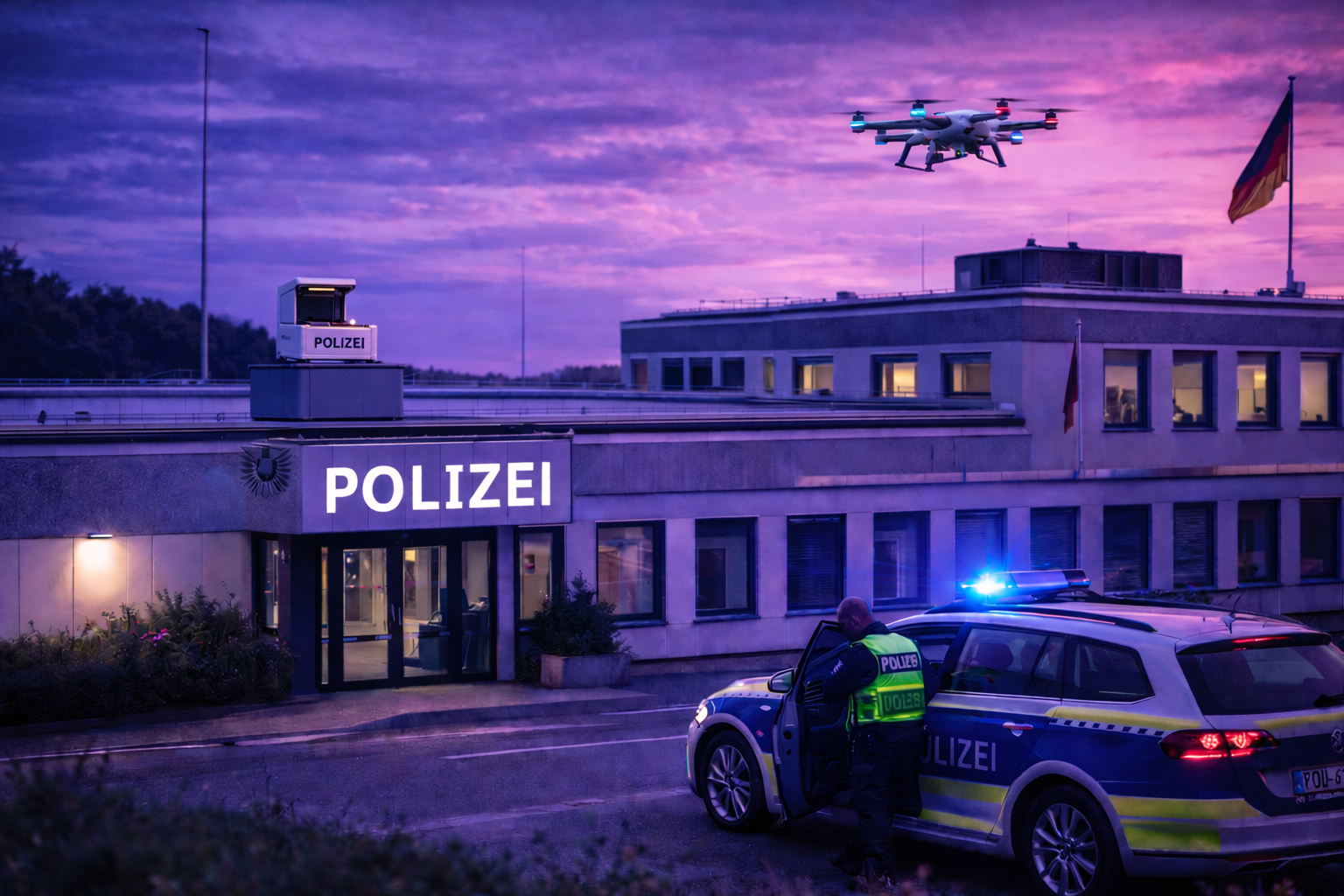
The project aimed to automate the process from receiving an emergency call to obtaining live imagery from the scene, connecting drone operations seamlessly with control room infrastructure and user interfaces.
Challenge
Integration into Critical Control Environments
Emergency control centers operate in mission-critical environments where reliability, cybersecurity, and operational continuity are essential.
Integrating automated drone dispatch into these systems required maintaining full compatibility with existing dispatch, communication, and incident management applications.
Operational Validation under Real Conditions
The system had to demonstrate that beyond visual line-of-sight (BVLOS) drone operations could be initiated safely and automatically through the control room software.
At the same time, it needed to comply with aviation and data protection standards, proving the feasibility of real-time emergency drone support in live scenarios.
For each drone flight a comprehensive Specific Operations Risk Assessment (SORA) had to be executed to align with EGRED2 recommendation.
Goal
Design an end-to-end solution based on client’s technology including digital services to ensure operational, technical and legal compliance.
The challenge was to support the client to successfully validate their technology fit to the market demands and to underline client’s innovation leadership in this domain.
Approach
Automation Embedded in Control Room Workflows
The project focused on integrating the Automated Drone Dispatch (ADD) capability directly into the existing control room ecosystem.
Once an emergency call was received, the system automatically used incident location data to trigger a connected drone launch.
This enabled end-to-end automation from the initial emergency call to the delivery of the first live image, all within the user’s existing operational environment.
Seamless System Integration
The solution combined 5G connectivity with proven control center software, ensuring uninterrupted communication between dispatchers, drones, and emergency units.
Incoming live video streams and sensor data were transmitted directly into the operator’s interface, providing immediate visual confirmation without the need for additional tools or processes.
Structured Research and Innovation Framework
Development and testing were conducted within a collaborative R&D framework, bringing together partners from telecommunications, software development, and emergency services.
This setup ensured coordinated validation, clear governance, and scalability for future operational deployment across multiple use cases.
Result
Direct Drone Dispatch Integration in Public Safety Workflows
The initiative successfully demonstrated the first operational integration of automated drone dispatch within emergency control center systems.
It showed that drones could become an integrated part of existing command and control processes, rather than operating as separate assets.
Improved Response and Decision-Making
By automating data collection through the control room, live aerial imagery and sensor data became available almost immediately after an emergency call.
This improvement significantly reduced response time and provided decision-makers with reliable information for early situational assessment.
Blueprint for Future Emergency Operations
The project established a reference model for digital integration in public safety, proving how automation and secure connectivity can enhance operational performance and cross-agency coordination.
It demonstrated a viable pathway for scaling automated drone dispatch in future smart city and emergency response frameworks.
Key Insight
Integrating automated drone operations into existing control room processes marks a decisive step toward digital transformation in public safety.
By embedding drone deployment directly into established communication and dispatch workflows, emergency organizations can access real-time aerial data within minutes after an incident report.
This project highlights how the client’s automation, interoperability, and networked communication technology can enhance situational awareness, reduce response times, and support informed decision-making in critical missions.